Granada and Erasmus: why it's one of the most beloved destinations for international students
The reasons become clear the moment you walk through the city. An atmosphere that weaves together eight centuries of Moorish history with a university life that spills into the streets well past midnight, free tapas with every drink, and a cost of living that stays below that of Madrid and Barcelona. But precisely because Granada draws so many students, the rental market empties out fast — and the most sought-after neighbourhoods go first. Anyone planning a semester or the full academic year in 2026 should treat the search for Erasmus accommodation in Granada 2026 as the first decision to make, not the last.
This guide covers neighbourhoods, price ranges, types of accommodation and practical tips for booking without the stress.
**The last Arab stronghold in Europe**
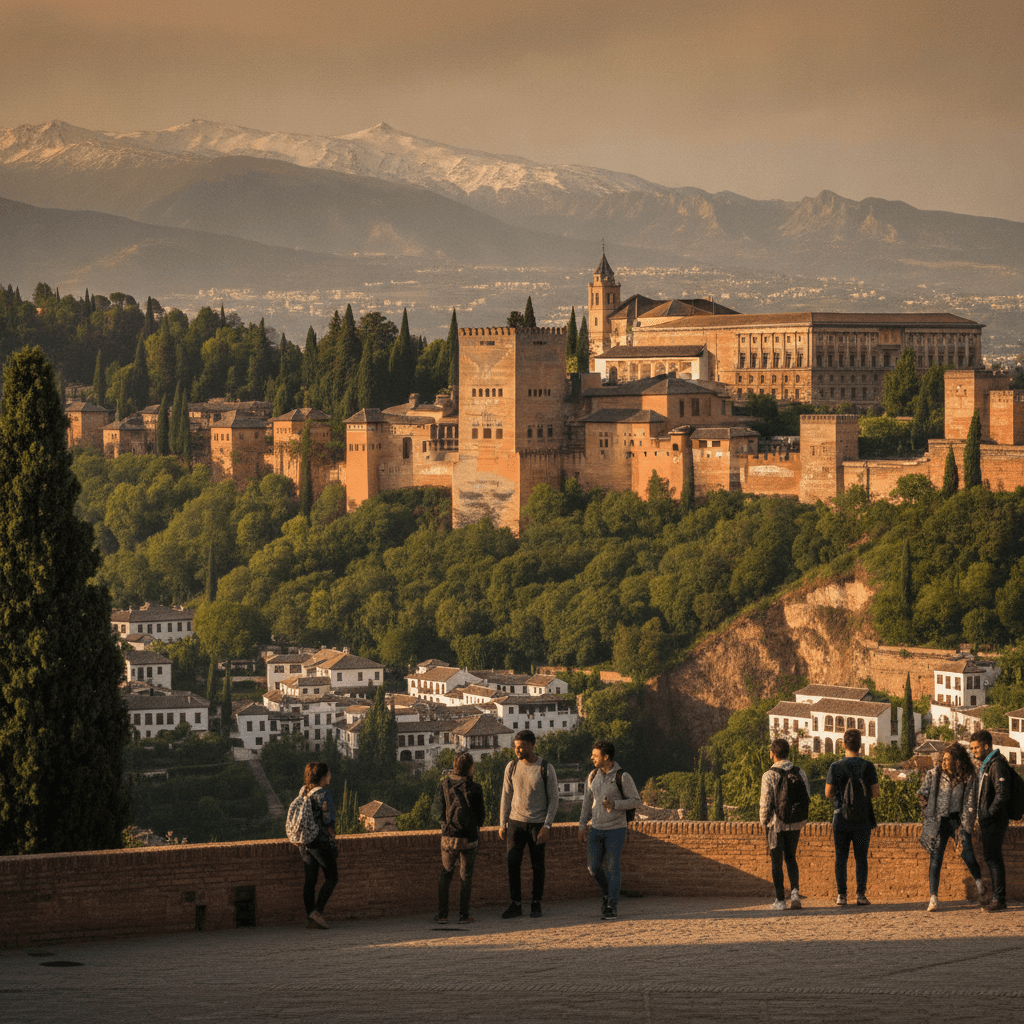
On 2 January 1492, Boabdil, the last Nasrid emir, handed the keys of the Alhambra to the Catholic Monarchs. That surrender ended nearly eight centuries of al-Andalus and marked the fall of the last Muslim kingdom in Western Europe. Granada had been the final outpost of that world — the city to which the Nasrid dynasty had retreated while the rest of the Iberian Peninsula fell, and where it had therefore concentrated the best of its art: courtyards, fountains, Kufic inscriptions, plasterwork that fragments light, gardens designed as earthly visions of paradise. Students who study in Granada live alongside this legacy without having to seek it out. The Alhambra is visible from the street, from windows, from the rooftops of the Albaicín at sunset, and its red silhouette above the hill is one of the reasons why many Erasmus students, long after returning home, still say that Granada was unlike any other city they had ever lived in.
The best neighbourhoods for Erasmus students in Granada

Granada isn't a large city, but its neighbourhoods have very different characters. Choosing the right one can make the difference between a lively Erasmus experience and a quieter one.
Realejo and Centro: perfect location, mid-range prices
El Realejo, the old Jewish quarter, remains one of the top choices for international students. It's a short walk from the Alhambra, packed with bars and venues, and well connected to the university campuses. A room in a shared flat here costs between €400 and €490 per month. The Centro offers a similar dynamic — maximum livability, plenty of amenities — with prices running slightly higher for single rooms.
Albaicín (Albayzín): unique atmosphere, but worth thinking through
The Albaicín is a UNESCO World Heritage site — a maze of white-walled lanes overlooking the city. It's romantic and full of character, but there are two practical things worth knowing before you sign anything: the steep streets make cycling largely impractical, and parts of the neighbourhood have shifted more towards tourism than student life. Prices range from €410 to €490 per month for a room in a shared flat, rising to €900 per month for an entire apartment.
Ronda and Arabial: the ideal middle ground for those who want a quieter life
Ronda appeals to students who want a good quality of life without overspending. Close enough to the centre but away from the most intense nightlife, it offers shopping centres, supermarkets, gyms and green spaces. Prices stay below those of the Albaicín and Realejo, and there's a wider supply of rooms — which means more options even if you start your search a little later.
Cartuja: for students at the science campuses
Cartuja is home to one of the UGR's main campuses, with a university canteen and sports facilities. If your faculty is based there, living nearby will save you time and transport costs every single day. Rents tend to be slightly lower than in the historic centre.
Zaidín: affordable and well connected
Zaidín attracts students who want to keep rent low while staying connected to the rest of the city. It's a residential, laid-back neighbourhood with solid public transport links and a local feel that has little to do with Granada's tourist postcard — which, for many, is exactly the point.
Erasmus accommodation prices in Granada in 2026
Here's an up-to-date overview to help you plan your budget:
| Accommodation type | Typical neighbourhood | Estimated monthly price |
|---|---|---|
| Room in shared flat | Realejo, Centro | €400–€490 |
| Room in shared flat | Albaicín, Ronda | €410–€490 |
| Room in shared flat | Cartuja, Zaidín | €320–€420 |
| Entire apartment (studio) | Realejo, Albaicín | €750–€900 |
| Student residence | Various | €500–€700 (varies by facility) |
Important: the rent typically covers the base amount plus community fees ("comunidad"), but generally does not include electricity, water or gas. Always clarify what's included before signing anything — over a semester, the difference can add up to several hundred euros.
Types of accommodation: which one is right for you?
There are three main options for Erasmus students in Granada:
- 1Room in a shared flat (piso compartido). The most common option and the one most recommended for anyone who wants the full Erasmus experience. You'll be living with other students — often international — and your social life starts from day one without having to engineer it. Costs are reasonable and the choice of neighbourhoods is wide.
- 2Entire apartment or studio. A good fit for couples or anyone who values privacy, or for those staying for an internship or a longer period. Prices are noticeably higher, but you get complete independence.
- 3Student residence. Structured, with services like a canteen, wi-fi and cleaning included, but less flexible on contracts and often priced similarly to — or higher than — a shared flat. Some of the UGR's historic residences, such as the Corrala de Santiago in Realejo or the Carmen de la Victoria in the Albaicín, are reserved for visiting researchers and PhD students.
**Flamenco in the caves of Sacromonte**
On the hill rising beside the Albaicín, Sacromonte is home to a musical tradition found nowhere else in Spain. The Roma families who arrived in Granada after 1492 carved their homes into the clay of the hillside, and in those cuevas they encountered the Moriscos — Muslims who had stayed on after the Reconquista. From that meeting came the zambra, whose name derives from the Arabic zamra, meaning a celebration with music. Not a genre invented at a desk, but a wedding rite: three dances in sequence — the alboreá, the cachucha and the mosca — each tied to a specific moment in the Roma ceremony, accompanied by singing and a guitar that follows the compás of tangos and tientos, solemn and understated at once. Philip II banned it as an indecent dance, and the Roma kept performing it in secret for generations. In the twentieth century the caves became performance spaces, and the neighbourhood reached its peak in the 1960s, when nearly all of its six thousand inhabitants could sing, dance or play. Then came the floods of 1963, the collapses, the exodus of many families. What remains today can still be heard in the surviving caves — and it's worth a night out: this isn't tablao flamenco, it's the sediment of two peoples who shared the same hillside.
When to start looking for Erasmus accommodation in Granada
This is the most important piece of advice in this entire guide: start earlier than you think you need to. Erasmus semesters at the UGR typically begin in September, for the autumn term, and in February, for the spring term. The best listings in the central neighbourhoods are gone 3 to 5 months before the start date, because the competition isn't just local — it includes every other Erasmus student arriving in the same week, and Granada hosts more of them than almost any other university in Europe.
- Autumn semester (September/October): start your search by April/May
- Spring semester (February): start your search by October/November
How to book accommodation safely: avoiding scams
The student rental market in Granada — like in any highly sought-after university city — unfortunately attracts fake listings and properties that look nothing like their photos. The most common warning signs:
- A price unusually low compared to the neighbourhood average
- A request for a deposit via bank transfer before you've even seen the place (not even on a video call)
- A landlord who is "abroad" and unable to show you the property
- No written rental contract
On ESH (Erasmus Student Housing), every host's identity is verified before their listing goes live. The funds you pay are protected via Stripe until check-in: the first month's rent is only transferred to the host 24 hours after you arrive, giving you time to confirm the property matches what was advertised. In the event of a verified material discrepancy, the refund is full and includes the ESH Commission.
Before booking, you can also see your future flatmates' nationality and gender, and send multiple requests in parallel with no charge until a host approves yours.
Practical life in Granada: what the tourist guides don't tell you
- Free tapas: they're real, and not a myth invented for tourists. With almost every drink at a bar, you get something to eat. It's a cornerstone of Granadan culture and makes a genuine dent in your monthly food budget.
- Transport: Granada has an urban bus network (the LAC lines) and a light metro — the tranvía — connecting the city centre to the university area. A monthly student pass costs around €20–€30.
- Internet: almost all student flats include wi-fi or share the cost among flatmates.
- Climate: summers above 35°C and cool winters, with the snow-capped Sierra Nevada just a short drive away. Make sure your flat has adequate heating — Granada winters are real, whatever you might assume about Andalusia.
Conclusion: start your search early and book with confidence
Granada remains one of the most rewarding Erasmus destinations you can choose: a university that welcomes more international students than almost any other in Europe, a vibrant social scene, a landscape that goes from the Sierra Nevada to the coast in an hour, and a cost of living that's still manageable. What can derail the experience isn't the city itself — it's arriving unprepared on the housing front.
Explore Erasmus accommodation in Granada 2026 on eshousing.com and find the right room in the neighbourhood that suits you — knowing that every listing has been verified and that your payment is protected from start to finish.
FAQ: Erasmus accommodation in Granada 2026
How much does it cost to live in Granada as an Erasmus student? Adding up rent (€400–€500), food (€150–€250), transport (around €25) and going out, a realistic monthly budget falls between €700 and €900 — less than Madrid or Barcelona.
Which neighbourhood do most international students choose? Realejo and Centro are the top picks for their central location and social life. Those looking for something quieter or more affordable tend to go for Ronda or Zaidín.
How long are rental contracts for Erasmus students? Contracts for Erasmus students typically cover 5 to 10 months, aligned with academic semesters. Some landlords also accept shorter stays for internships or visiting periods.
What happens if the property doesn't match the listing when I arrive? On ESH, in the event of a verified material discrepancy, the refund is full and includes the ESH Commission. Report the issue to the ESH team within the first few hours of check-in.
Can I bring a pet? It depends on the host. Before sending a request, check the preferences listed in the ad or message the host directly through the platform.